

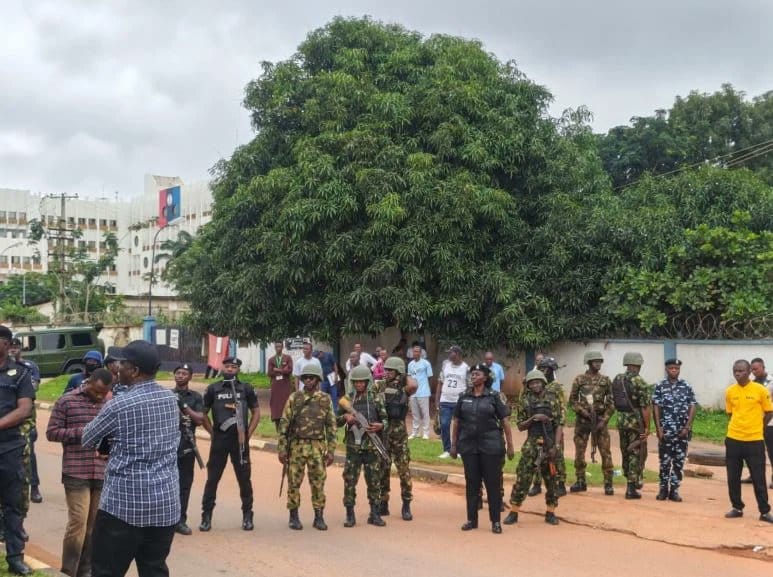
Retired military personnel gathered in Abuja on Wednesday, August 19, to demand the implementation of consequential adjustments to their...

By Paul Ejime*
After Guinea-Bissau’s former president, Umaro Sissoco Embalo, staged a self-coup in November 2025 to avoid an election defeat and handed power to his military allies, ECOWAS has been engaged in frenetic diplomatic damage control to restore some sanity in the country, notorious for its history of political instability.
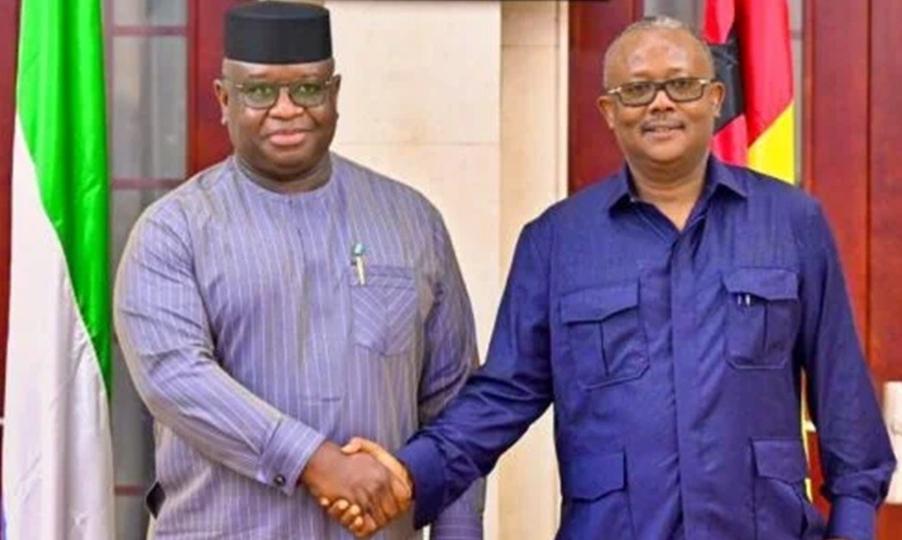
However, the regional peace efforts have been marred by internal division within ECOWAS, with some leaders, notably from Senegal and Sierra Leone, the Chairman of the Authority of Heads of State and Government, siding with Embalo. Also, the leadership of the ECOWAS Commission has not provided the desired leadership or orientation for a quick or proactive solution.
Before the November 2025 coup – the fourth reported failed or successful putsch since 2022 – Embalo had repeatedly violated ECOWAS Protocols, including dissolving the parliament twice, suspending the constitution, silencing the opposition, and emasculating the electoral commission and the judiciary, without any push-back from ECOWAS.
Even the ECOWAS Stabilisation Support Mission in Guinea-Bissau (ESSMGB), is considered as a Palace Guard contingent, due to its strange mandate cobbled together by the management of the previous ECOWAS Commission.
From several missteps in the damage-limitation efforts, it was no surprise that the latest regional move, a delegation by the ECOWAS Committee of Chiefs of Defence Staff (CDDS) to Guinea-Bissau, ran into a storm of bribery allegations.
The delegation, comprising defence chiefs from Ghana, Nigeria, Senegal and Sierra Leone, was in Bissau from 19 to 23 June 2026 for talks with the junta government led by Gen. Horta Inta-A and other stakeholders on the “implementation of the revised mandate of ESSMGB; its operational requirements; the planned draw-down and withdrawal process and other matters relating to peace, security and stability in Guinea-Bissau.”
But before the delegation departed Bissau, social media was awash with reports alleging that one of the defence chiefs had discovered a parcel in his hotel room. According to the report, an investigation involving the hotel CCCTV footage revealed that the parcel contained CFA 15 million francs, allegedly traced to an aide of a senior junta government official.
“The CCDS categorically rejects these allegations as entirely false, unfounded and without any factual basis,” the Committee said in a statement, adding that “no member of the delegation was approached with, offered or involved in any form of bribery or improper inducement during the visit.”
It also explained that “no complaint, report or evidence relating to the allegations was brought to the attention of the delegation, the ESSMGB or the hotel where the delegation stayed.”
The CDDS noted that both Guinea-Bissau’s Transitional National Council and the management of the Bissau Royal Hotel had also publicly denied the allegations.
In its statement, the hotel said, “At no time did the management or any authorised employee of the hotel hand over, make available, or provide video surveillance footage to members of the ECOWAS Mission, external entities or any third parties related to the allegedly disclosed facts.”
Weighing in on the allegations, the Guinea-Bissau junta government said in a statement that it “has opened criminal proceedings against journalist Paula Borges for ‘fake news’ about an alleged bribe to ECOWAS defence chiefs.”
It described the media report as “a gross exercise of pure speculation” based on “rumours and lies fed on social networks”, without “any factual basis, material proof or technical rigour,” adding that the “text violates ethical principles of …truth and journalistic responsibility.”
The Council called Paula Borges a “mercenary of communication” and “activist disguised as a professional,” driven by “feelings arising from the end of privileges” under the old regime, adding that this “justified the expulsion and closure of RTP (Portuguese Radio and TV broadcasting channel) in (Guinea-Bissau)”.
Serious as the bribery allegation might seem, it only masks the depth of the political crisis in Guinea-Bissau, a country which can best be described as an ECOWAS drainpipe.
With four of its 15 member States under military dictatorship, and three of them having withdrawn their membership, under the name of Alliance of Sahel States, AES, the existential challenge facing ECOWAS in redeeming its disappearing glory cannot be taken for granted.
The CCDS said its “mission achieved its intended objectives, including consultations with Guinea-Bissau authorities and other stakeholders on the revised mandate of the (ESSMGB).”
However, there is compelling evidence that under the present mandate, the ECOWAS military missions in Guinea-Bissau and the Gambia are largely for “regime protection.” This defeats the argument that they are stabilising peace, when, for instance, the presence of the ESSMGB failed to prevent four military coup plots in Guinea-Bissau.
Moreover, ECOWAS now owes the troop-contributing countries of the two missions more than US$100 million with no tangible results.
Apart from the need for an urgent review of their operational mandates, the draw-down and withdrawal of the military missions are overdue, so that the leadership of both countries can sit up and stop manipulating the presence of the regional soldiers to commit atrocities without consequences.
Using military missions to prop up political leadership is antithetical to the principles of multiparty democracy, which ECOWAS leaders have signed up to under various regional instruments, protocols, and normative frameworks.
More importantly, Embalo and his military accomplices must never be allowed to profit from the unconstitutional change of government, which they engineered and prosecuted, thereby setting a dangerous example for the disintegration of the ECOWAS Community.
If ECOWAS cannot prevail on the junta leaders and the electoral Commission to release the results of the 24 November 2025 presidential election, an inclusive transitional Government of National Unity should be constituted to stabilise the polity and organise fresh elections from which Embalo and the military junta leaders must not participate.
Whoever is supporting the continuation of Embalo’s authoritarianism or unconventional changes of government elsewhere in the region is worse than an enemy of Guinea-Bissau, the estimated 400 million ECOWAS Community citizens, and African progress.
The new ECOWAS Commission management, expected to assume duties from August 2026, has its job cut out. But they have a free template for succeeding from the legacy of former Commission president, Ambassador James Victor Gbeho, who passed on recently at the ripe age of 91 after a distinguished and high-impact career in international diplomacy, governance, and regional integration.
*Ejime is a Global Affairs Analyst and Consultant on Peace & Security and Governance Communication
Related Posts
By Ajayi Osahon Media Manager, Centre for Community and Oceanic Law The ECOWAS Parliament has called for sanctions against...
By Michael C. Agbo* The Board of Trustees of the Centre for Community Law has instituted a public-interest human...