


By Paul Ejime Thedeath of 37 suspected illegal miners, mainly youths in the detention facility of Nigeria’s Civil Defence...

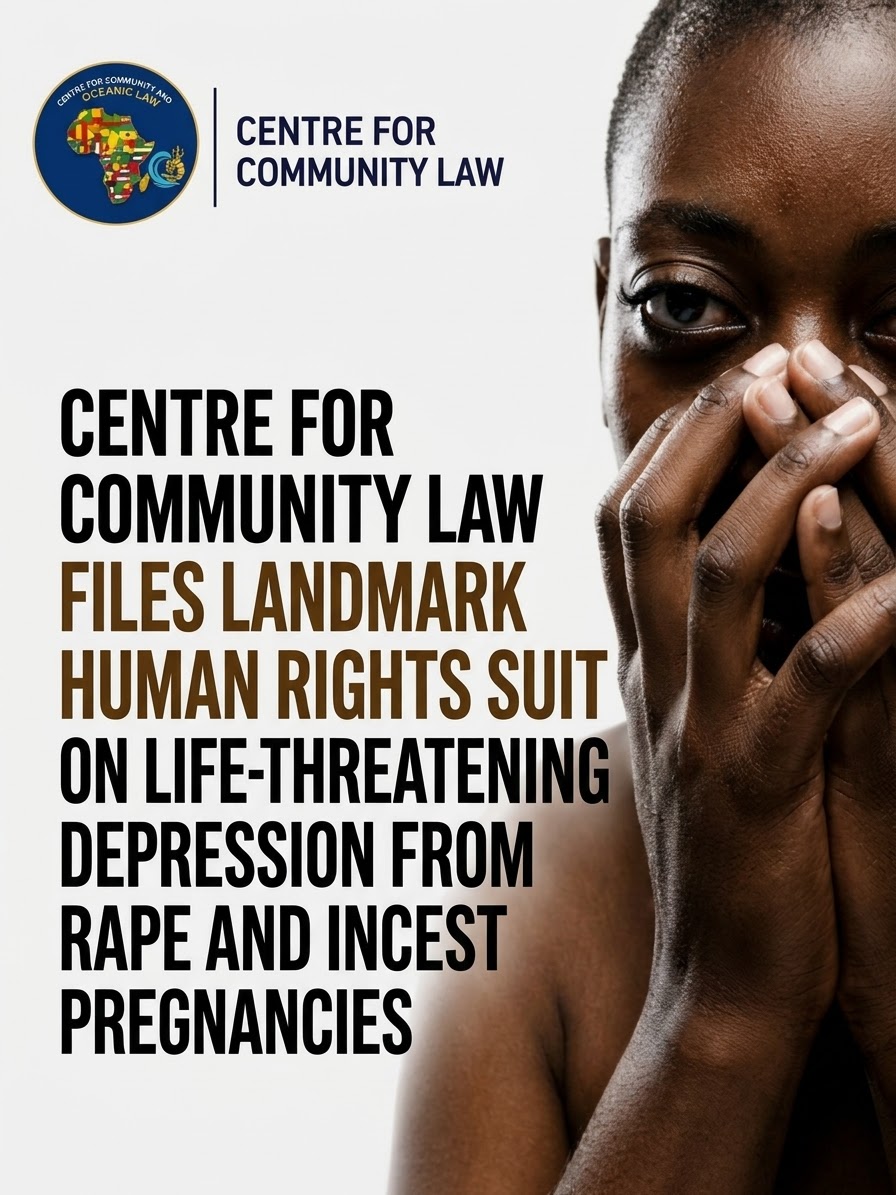
The Incorporated Trustees of the Centre for Community Law (CFCOMLAW) has commenced a public interest human rights action against the Federal Republic of Nigeria before the Federal High Court, Abuja Judicial Division, in Suit No. FHC/ABJ/CS/2369/2026, on Wednesday 30th September 2026.
The suit seeks judicial clarification of important constitutional, statutory, and human rights questions concerning the treatment of women and girls who suffer severe depression accompanied by suicidal ideation or suicidal tendencies as a consequence of pregnancies resulting from rape or incest.
At the heart of the case is the question whether severe psychiatric conditions arising from rape or incest, including suicidal tendencies, constitute circumstances capable of threatening the life of a pregnant woman within the meaning of the “life-preservation” exceptions contained in the Criminal Code and Penal Code.
The action also invites the Court to determine whether an interpretation of the Criminal Code and Penal Code that excludes severe depression and suicidal tendencies from circumstances threatening the life of the mother is compatible with the rights to life, dignity, and private life guaranteed under the Constitution of the Federal Republic of Nigeria, 1999 (as amended), and the African Charter on Human and Peoples’ Rights.
In addition, the Centre seeks judicial pronouncements on the applicability and enforceability in Nigeria of the Protocol to the African Charter on Human and Peoples’ Rights on the Rights of Women in Africa (Maputo Protocol), on the basis that the Protocol was adopted pursuant to and in furtherance of the African Charter on Human and Peoples’ Rights and is therefore an integral component of the African human rights system established under the Charter. The Centre further seeks a determination of whether the Maputo Protocol is applicable in Nigeria by virtue of the African Charter on Human and Peoples’ Rights (Ratification and Enforcement) Act, and whether, having also been adopted within the framework of the African Union established under the Constitutive Act of the African Union, it is enforceable in Nigeria through the Treaty Establishing the African Union (Ratification and Enforcement) Act. The action accordingly invites the Court to pronounce on the legal effect of Nigeria’s obligations under the African Charter, the Maputo Protocol, and the Treaty Establishing the African Union within the Nigerian legal system.
The Centre also seeks consequential orders directing relevant authorities to give effect to the Court’s interpretation of the law and restraining the criminalization of pregnancy termination solely because the life-threatening condition relied upon is psychiatric or psychological in nature where the statutory requirements for preserving the life of the mother have otherwise been satisfied.
According to the Centre, the action is not brought on behalf of any individual victim and does not seek monetary compensation. Rather, it is a public interest litigation intended to secure judicial guidance on the protection of women and girls facing severe mental health consequences arising from pregnancies resulting from rape or incest, while ensuring compliance with Nigeria’s constitutional, regional and international human rights obligations.
The Centre for Community Law remains committed to promoting access to justice, protecting vulnerable persons, advancing the rule of law, and strengthening the protection of fundamental human rights through strategic litigation, legal aid, research, and policy advocacy.
Signed
The Incorporated Trustees of the Centre for Community Law (CFCOMLAW)
For further enquiries:
Centre for Community Law (CFCOMLAW)
9 Agho Street, Ekehuan Road, Benin City, Edo State, Nigeria.
30 September 2026
Related Posts

The Centre for Community Law (CCL) is deeply saddened by the tragic death of thirty-seven (37) persons while in...
By Paul Ejime* Another International Day for the Remembrance of the Slave Trade and its Abolitionpassed almost quietly on...